
Universal Pipette Tips
Disposable pipette tips designed to fit single and multichannel pipettes from most manufacturers; offer acceptable performance compared to pipette specific tips and can be used with a variety of pipette models.
Single-use universal pipette tips are designed for compatibility with most mechanical and electronic single and multichannel pipettors.
Universal pipette tips are available in a range of types, sizes, colors, styles, and packaging configurations and may be designed for specific purposes or tasks.
- Capacity or volume based on the pipettor size
- Filters to reduce contamination and cross-contamination
- Color
- Sterility or autoclavability
- Tip style: beveled, tapered, wide bore, round, flat, or gel-loading
- Length: short or extended
- Purity: metal-free or DNase-, RNase-, ATP-, Bioburden-, PCR inhibitor-, endotoxin-, or pyrogen-free for genomic and biologic applications
- Surface treatments to reduce retention
- Packaging options to help facilitate re-stocking or eliminate waste

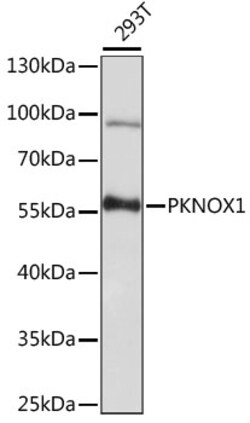
ABclonal Technology PKNOX1 Rabbit pAb

Enables sequence-specific double-stranded DNA binding activity. Predicted to be involved in angiogenesis and regulation of transcription by RNA polymerase II. Predicted to act upstream of or within camera-type eye development, hemopoiesis, and positive regulation of transcription by RNA polymerase II. Predicted to be located in cytoplasm and nucleus. Predicted to be part of chromatin.

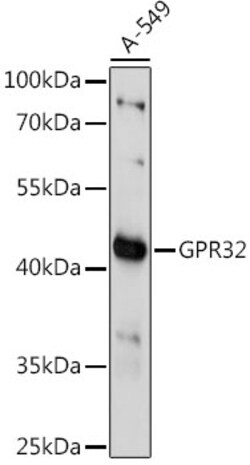
ABclonal Technology GPR32 Rabbit pAb
This gene is intronless and encodes a member of the G-protein coupled receptor 1 family. The encoded protein binds to resolvin D1 and lipoxin A4 and has been linked to pulmonary inflammation. A related pseudogene has been identified on chromosome 19.
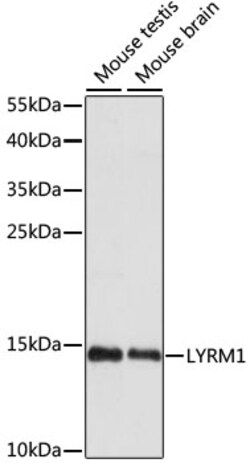
ABclonal Technology LYRM1 Rabbit pAb
The protein encoded by this gene belongs to the mitochondrial leucine/tyrosine/arginine motif family of proteins. Proteins of this family are short polypeptides that contain a leucine/tyrosine/arginine motif near the N-terminus. This gene is widely expressed with high levels in omental adipose tissue of obese individuals. In adipose tissue, the protein is localized to the nucleus where it promotes preadipocyte proliferation and lowers the rate of apoptosis to regulate adipose tissue homeostasis. Overexpression of this gene in adipocytes causes abnormal mitochondrial morphology and mitochondrial dysfunction. Alternative splicing results in multiple transcript variants.
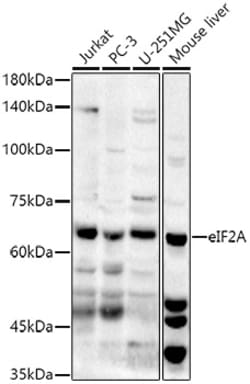
ABclonal Technology eIF2A Rabbit pAb
This gene encodes a eukaryotic translation initiation factor that catalyzes the formation of puromycin-sensitive 80 S preinitiation complexes and the poly(U)-directed synthesis of polyphenylalanine at low concentrations of Mg2+. This gene should not be confused with eIF2-alpha (EIF2S1, Gene ID 1965), the alpha subunit of the eIF2 translation initiation complex. Although both of these proteins function in binding initiator tRNA to the 40 S ribosomal subunit, the encoded protein does so in a codon-dependent manner, whereas eIF2 complex requires GTP. Alternative splicing of this gene results in multiple transcript variants encoding different isoforms.
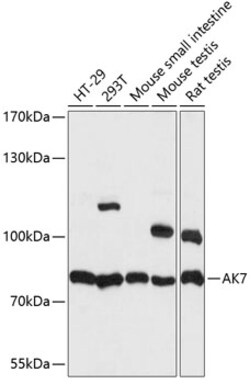
ABclonal Technology AK7 Rabbit pAb
This gene encodes a member of the adenylate kinase family of enzymes. The encoded enzyme is a phosphotransferase that catalyzes the reversible phosphorylation of adenine nucleotides. This enzyme plays a role in energy homeostasis of the cell. Alternative splicing results in multiple transcript variants. Mutations in the mouse gene are associated with primary ciliary dyskinesia.
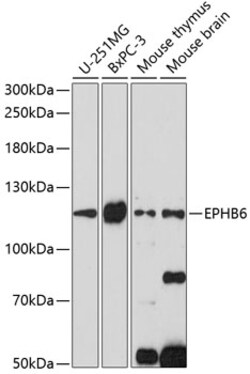
ABclonal Technology EPHB6 Rabbit pAb
This gene encodes a member of a family of transmembrane proteins that function as receptors for ephrin-B family proteins. Unlike other members of this family, the encoded protein does not contain a functional kinase domain. Activity of this protein can influence cell adhesion and migration. Expression of this gene is downregulated during tumor progression, suggesting that the protein may suppress tumor invasion and metastasis. Alternative splicing results in multiple transcript variants.
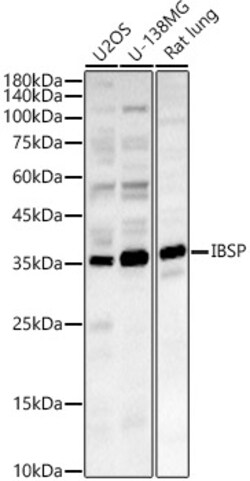
ABclonal Technology IBSP Rabbit pAb
The protein encoded by this gene is a major structural protein of the bone matrix. It constitutes approximately 12% of the noncollagenous proteins in human bone and is synthesized by skeletal-associated cell types, including hypertrophic chondrocytes, osteoblasts, osteocytes, and osteoclasts. The only extraskeletal site of its synthesis is the trophoblast. This protein binds to calcium and hydroxyapatite via its acidic amino acid clusters, and mediates cell attachment through an RGD sequence that recognizes the vitronectin receptor.
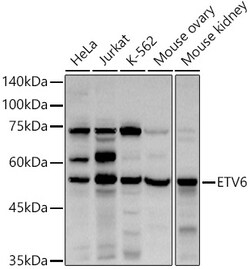
ABclonal Technology ETV6 Rabbit pAb
This gene encodes an ETS family transcription factor. The product of this gene contains two functional domains a N-terminal pointed (PNT) domain that is involved in protein-protein interactions with itself and other proteins, and a C-terminal DNA-binding domain. Gene knockout studies in mice suggest that it is required for hematopoiesis and maintenance of the developing vascular network. This gene is known to be involved in a large number of chromosomal rearrangements associated with leukemia and congenital fibrosarcoma.
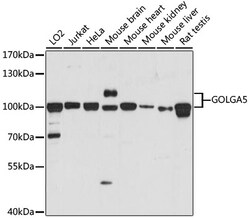
ABclonal Technology GOLGA5 Rabbit pAb
The Golgi apparatus, which participates in glycosylation and transport of proteins and lipids in the secretory pathway, consists of a series of stacked cisternae (flattened membrane sacs). Interactions between the Golgi and microtubules are thought to be important for the reorganization of the Golgi after it fragments during mitosis. This gene encodes one of the golgins, a family of proteins localized to the Golgi. This protein is a coiled-coil membrane protein that has been postulated to play a role in vesicle tethering and docking. Translocations involving this gene and the ret proto-oncogene have been found in tumor tissues, the chimeric sequences have been designated RET-II and PTC5. A pseudogene of this gene is located on the short arm of chromosome 5.
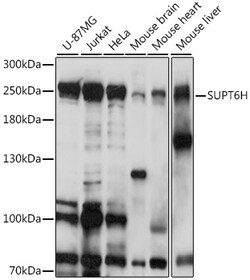
ABclonal Technology SUPT6H Rabbit pAb
Enables histone binding activity. Involved in negative regulation of histone H3-K27 methylation and positive regulation of transcription elongation from RNA polymerase II promoter. Predicted to be located in nucleoplasm. Predicted to be part of transcription elongation factor complex. Predicted to be active in transcriptionally active chromatin.
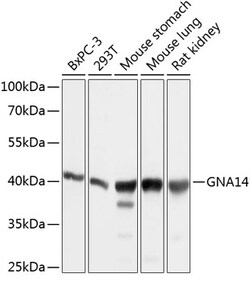
ABclonal Technology GNA14 Rabbit pAb
This gene encodes a member of the guanine nucleotide-binding, or G protein family. G proteins are heterotrimers consisting of alpha, beta and gamma subunits. The encoded protein is a member of the alpha family of G proteins, more specifically the alpha q subfamily of G proteins. The encoded protein may play a role in pertussis-toxin resistant activation of phospholipase C-beta and its downstream effectors.
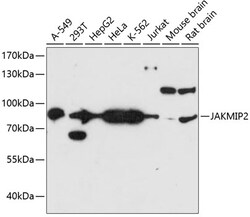
ABclonal Technology JAKMIP2 Rabbit pAb
The protein encoded by this gene is reported to be a component of the Golgi matrix. It may act as a golgin protein by negatively regulating transit of secretory cargo and by acting as a structural scaffold of the Golgi. Alternative splicing results in multiple transcript variants.
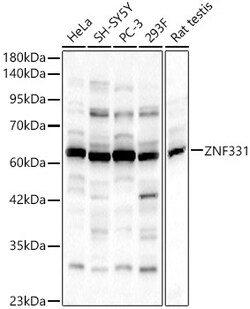
ABclonal Technology ZNF331 Rabbit pAb
This gene encodes a zinc finger protein containing a KRAB (Kruppel-associated box) domain found in transcriptional repressors. This gene may be methylated and silenced in cancer cells. This gene is located within a differentially methylated region (DMR) and shows allele-specific expression in placenta. Alternative splicing and the use of alternative promoters results in multiple transcript variants encoding the same protein.
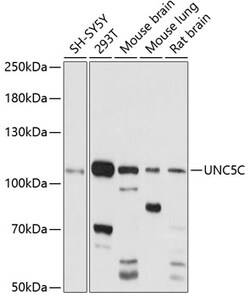
ABclonal Technology UNC5C Rabbit pAb
This gene product belongs to the UNC-5 family of netrin receptors. Netrins are secreted proteins that direct axon extension and cell migration during neural development. They are bifunctional proteins that act as attractants for some cell types and as repellents for others, and these opposite actions are thought to be mediated by two classes of receptors. The UNC-5 family of receptors mediate the repellent response to netrin, they are transmembrane proteins containing 2 immunoglobulin (Ig)-like domains and 2 type I thrombospondin motifs in the extracellular region.
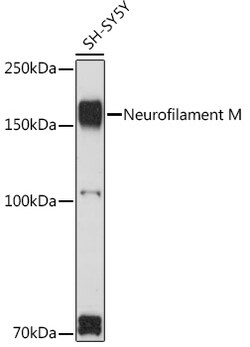
ABclonal Technology Neurofilament M Rabbit pAb
Neurofilaments are type IV intermediate filament heteropolymers composed of light, medium, and heavy chains. Neurofilaments comprise the axoskeleton and functionally maintain neuronal caliber. They may also play a role in intracellular transport to axons and dendrites. This gene encodes the medium neurofilament protein. This protein is commonly used as a biomarker of neuronal damage. Alternative splicing results in multiple transcript variants encoding distinct isoforms.